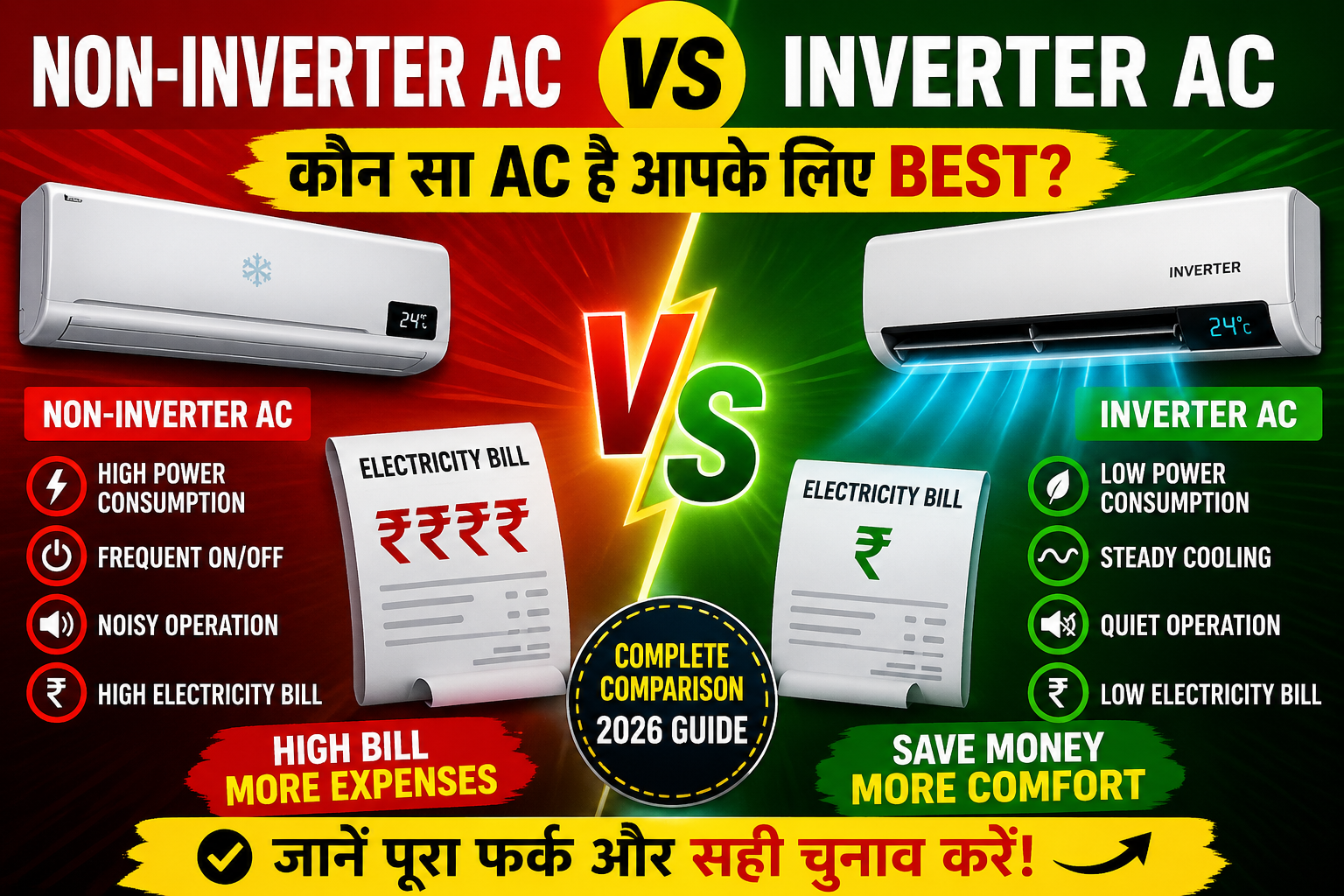

In this detailed guide, we will compare inverter and non-inverter air conditioners based on performance, power consumption, cost, maintenance, and long-term value—helping you make an informed decision.
What is an Inverter AC?
An inverter AC is designed with advanced technology that controls the speed of the compressor motor. Instead of turning ON and OFF repeatedly, the compressor runs continuously at variable speeds to maintain the desired temperature.
Key Features:
- Variable compressor speed
- Energy-efficient operation
- Consistent cooling
- Low noise levels
What is a Non-Inverter AC?
A non-inverter AC, also known as a fixed-speed AC, operates in a traditional way. The compressor runs at full capacity until the room reaches the desired temperature and then shuts off. Once the temperature rises again, it restarts.
Key Features:
- Fixed-speed compressor
- On/Off operation
- Lower initial cost
- Simple technology
Key Differences Between Inverter and Non-Inverter AC
1. Energy Efficiency
One of the biggest differences lies in energy consumption.
- Inverter AC: Uses less electricity because the compressor adjusts speed instead of restarting frequently.
- Non-Inverter AC: Consumes more power due to repeated ON/OFF cycles.
Verdict: Inverter AC wins in energy savings (up to 30–50%).
2. Cooling Performance
- Inverter AC: Provides faster and consistent cooling by adjusting compressor speed.
- Non-Inverter AC: Cooling fluctuates due to frequent compressor stops.
Verdict: Inverter AC offers smoother and more stable cooling.
3. Electricity Bill Impact
If you run your AC for long hours (6–10 hours daily), the difference in electricity bills becomes significant.
- Inverter AC: Lower monthly bills
- Non-Inverter AC: Higher electricity consumption
Example:
Inverter AC can save ₹800–₹1500 per month depending on usage.
4. Initial Cost
- Inverter AC: Higher upfront cost (₹3,000–₹8,000 more)
- Non-Inverter AC: Budget-friendly
Verdict: Non-inverter AC is cheaper initially.
5. Maintenance and Repair
- Inverter AC: Requires skilled technicians; repair cost can be slightly higher
- Non-Inverter AC: Easy to maintain and repair
Verdict: Non-inverter AC is simpler and cheaper to repair.
6. Noise Levels
- Inverter AC: Quieter operation due to continuous running
- Non-Inverter AC: Noisy due to frequent compressor switching
Verdict: Inverter AC is quieter.
7. Lifespan and Durability
- Inverter AC: Longer life due to less wear and tear
- Non-Inverter AC: More stress on compressor due to frequent starts
Verdict: Inverter AC lasts longer.
Detailed Comparison Table
| Feature | Inverter AC | Non-Inverter AC |
|---|---|---|
| Compressor Type | Variable speed | Fixed speed |
| Energy Efficiency | High | Low |
| Cooling | Consistent | Fluctuating |
| Noise | Low | Higher |
| Initial Cost | High | Low |
| Maintenance | Moderate | Easy |
| Electricity Bill | Lower | Higher |
| Lifespan | Longer | Shorter |
Which AC is Better for You?
Choose Inverter AC if:
- You use AC daily for long hours
- You want lower electricity bills
- You prefer silent operation
- You are looking for long-term savings
Choose Non-Inverter AC if:
- You use AC occasionally (2–3 hours/day)
- You have a limited budget
- You want low maintenance costs
- You need a simple and reliable option
Cost Analysis: Long-Term Savings
Let’s break it down:
- Extra cost of inverter AC: ₹5,000 (approx.)
- Monthly savings: ₹1,000 (average)
- Annual savings: ₹12,000
Conclusion: The inverter AC pays for itself within 6–12 months.
Environmental Impact
Inverter ACs are more eco-friendly because:
- They consume less electricity
- They reduce carbon emissions
- They use advanced refrigerants (in newer models)
If sustainability matters to you, inverter AC is the better choice.
Common Myths About Inverter AC
Myth 1: Inverter AC works only with inverter battery
Fact: It has nothing to do with power inverter systems.
Myth 2: Inverter AC always saves electricity
Fact: Savings depend on usage. Short usage may not show big savings.
Myth 3: Repair cost is extremely high
Fact: It’s slightly higher, but not drastically expensive.
Final Verdict
If you are planning to buy an air conditioner in 2026, the decision depends on your usage pattern.
- For daily and long usage, inverter AC is a smart investment.
- For occasional use and tight budget, non-inverter AC is still a practical choice.
However, considering rising electricity prices and the need for energy efficiency, inverter AC is the future and offers better value in the long run.